An Eight Phase Protocol
Eye Movement Desensitisation and Reprocessing (EMDR) is widely known for treating trauma, anxiety, and performance-related challenges.
However, many people mistakenly believe that EMDR is only about bilateral stimulation, such as eye movements or tapping.
In reality, its an eight-phase, evidence-based therapy that creates a safe and structured path to healing (Shapiro, 2018). To understand this more clearly, here’s an overview of the eight phases.
The Eight Phases of EMDR: A Holistic Approach to Healing

1. History Taking – First the therapist gathers background information, trauma history, and current concerns.
2. Client Preparation – This phase builds trust, teaches coping skills, and ensures readiness for deeper emotional work.
3. Assessment – Then together, you identify target memories, negative beliefs, and desired positive beliefs.
4. Desensitisation – Bilateral stimulation helps reprocess distressing memories and reduces emotional intensity.
5. Installation – Positive beliefs and self-perceptions are strengthened, creating, new neural pathways.
6. Body Scan – The therapist helps the client notice and release any residual physical tension.
7. Closure – Each session ends by ensuring the client feels grounded and stable before leaving.
8. Revaluation – Any remaining targets, triggers, or themes, you and your therapist work through in future sessions.
Through this process, clients can move beyond past trauma, reframe negative patterns, and develop lasting emotional balance (Shapiro & Solomon, 2010).
The Misconception About Bilateral Stimulation
Many assume EMDR is only about eye movements or tapping.
While bilateral stimulation plays a key role, it is only one element of a carefully structured treatment model.
In fact, true healing happens through preparation, memory reprocessing, and integration of healthier beliefs and emotional responses.
Research confirms that EMDR’s effectiveness lies in its full eight-phase structure—not just the stimulation itself (Lee & Cuijpers, 2013).
Why Phase 2 (Client Preparation) Is the Foundation of EMDR
A common misconception is that EMDR starts immediately with memory reprocessing.
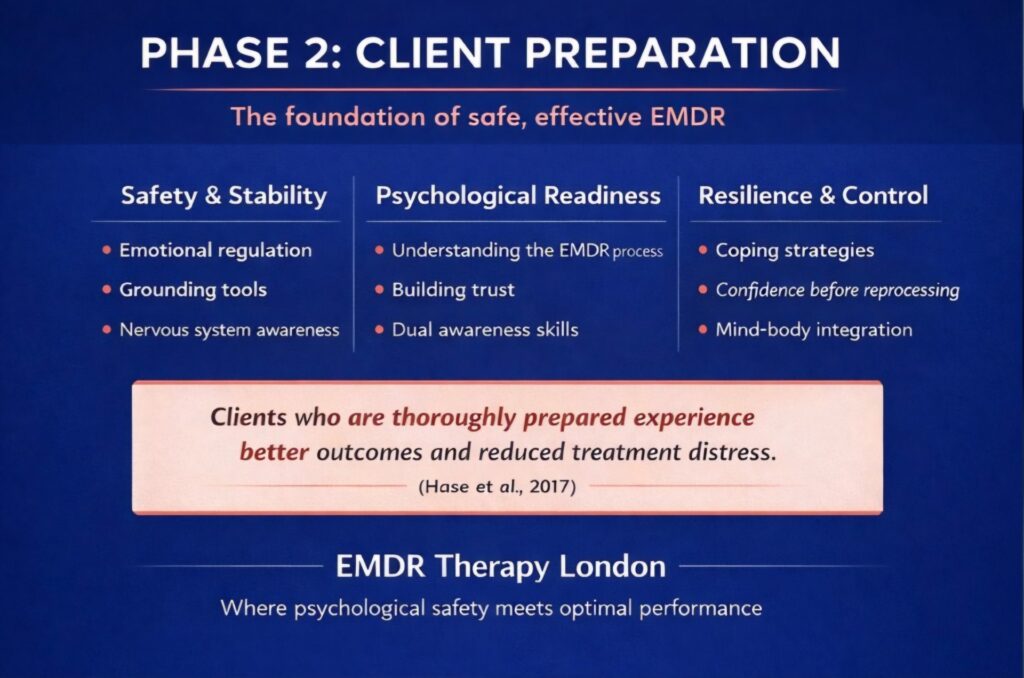
Importantly, Phase 2 – Client Preparation- is one of the most vital stages of the entire process.
This phase helps clients develop emotional regulation skills, coping mechanisms, and a sense of safety before deeper processing begins.
As a result, at EMDR Therapy London, we place great emphasis on this foundation phase.
By integrating mind-body principles from both psychological and physiological therapy, we prepare clients for transformative work.
This approach ensures:
- A safe, supportive environment where clients feel emotionally secure.
- Strong emotional resilience before processing traumatic or distressing memories.
- Improved performance and confidence through the development of empowering mindsets.
Research supports this phase as essential. Clients who undergo thorough preparation experience better long-term results and fewer therapy-related challenges (Hase et al., 2017).
Conclusion: EMDR as a Complete, Structured Path to Healing
In summary, EMDR is far more than guided eye movements – it’s a comprehensive, eight-phase approach to emotional transformation.
Through careful preparation, targeted processing, and integration. Ultimately, EMDR helps clients achieve lasting healing, resilience, and clarity.
References
Hase, M., Balmaceda, U. M., Ostacoli, L., Liebermann, P., & Hofmann, A. (2017). The AIP model of EMDR therapy and pathogenic memories. National library of medicine, https://pmc.ncbi.nlm.nih.gov/articles/PMC5613256/
Lee, C. W., & Cuijpers, P. (2013). A meta-analysis of the contribution of eye movements in processing emotional memories. National library of medicine, https://pubmed.ncbi.nlm.nih.gov/23266601/
Shapiro, F. (2018). Eye movement desensitisation and reprocessing (EMDR) therapy: Basic principles, protocols, and procedures (3rd ed.). Guilford Press.
Shapiro, F., & Solomon, R. M. (2010). Eye movement desensitisation and reprocessing. In B. J. Sadock, V. A. Sadock, & P. Ruiz (Eds.), Kaplan & Sadock’s Comprehensive Textbook of Psychiatry (9th ed., pp. 1961–1969). Lippincott Williams & Wilkins.